Is Longevity Activator worth it?
Worth a look (5.5/10). Longevity Activator stands out from most ClickBank supplements in one respect: it publishes a complete supplement facts panel with an exact milligram amount for every one of its 14 ingredients, formulated by a named naturopathic doctor, Ryan Shelton, and made in a third-party-tested, cGMP-audited US facility. The problem is what those numbers show once you compare them with the science the page itself cites. The headline ingredient, fisetin, is dosed at 25 mg a day, while the human senolytic trials this "zombie cell" story is built on use single or twice-weekly doses of roughly 20 mg per kilogram of body weight, on the order of 1,000 to 1,500 mg at once, an entirely different dosing strategy. Berberine-containing barberry, resveratrol, ashwagandha, turmeric and L-carnosine are all present at 10 to 25 mg, well under the 300 mg to multi-gram amounts used in the research typically cited for each of them. At $33 to $59 a month depending on bundle size, you are paying full anti-aging supplement prices for trace amounts of well-known compounds.
What we liked
- Full ingredient list with exact per-ingredient milligram amounts, not a single hidden blend total
- Named formulator (Dr. Ryan Shelton, N.D.) rather than an anonymous persona
- 180-day "empty bottle" refund, longer than most ClickBank supplements
- Made in a US, cGMP facility with a stated third-party testing claim
- Free of common allergens (gluten, dairy, soy, nuts) by the brand's own claims
What we didn't
- Fisetin, the product's headline ingredient, is dosed for daily use rather than the high-dose intermittent protocol its own senolytic research uses
- Several other ingredients (curcumin, berberine, resveratrol, ashwagandha, carnosine) sit at a fraction of typical study doses
- A cited pterostilbene study could not be verified in PubMed
- $33 to $59 a month depending on bundle size
- Testimonials feature extreme, unverified before/after claims
What is Longevity Activator?
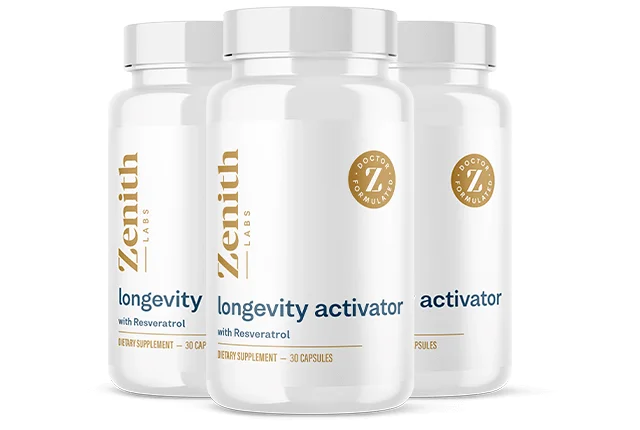
Longevity Activator is a Zenith Labs supplement built around the idea of clearing "senescent" or "zombie" cells through a process called autophagy, a real biological concept the page attributes to Mayo Clinic and Harvard research. It combines 14 ingredients across a "Cellular Garbage Disposal" blend (green tea extract, fisetin, resveratrol), a "Telomere Support" blend (Terminalia chebula's cousin arjuna bark, astragalus, purslane, ashwagandha), a nine-ingredient "Longevity Booster Blend," and a small absorption blend with black pepper and ginger extract.
Unlike many products in this niche, Longevity Activator publishes an exact supplement facts label rather than hiding doses behind a single proprietary-blend total. It lists Dr. Ryan Shelton, N.D., as the formulator, states the product is made in an FDA-inspected, cGMP facility in the US, and says it is third-party tested. It is vegetarian, and free of gluten, dairy, soy and nuts by its own claims.
It is sold through ClickBank under vendor account LONGACTIVE, which appears on the buyer's statement and handles checkout and refunds.
Format: Capsule supplement, 30 capsules per bottle, 1 a day. Sold by: Zenith Labs (sold through ClickBank).
What is on the Longevity Activator label?
Each row compares what the label or sales page states with what published research used. When an amount is missing, there is nothing to compare, and we say so.
The label is unusually complete for a ClickBank supplement, naming every ingredient and its exact milligram amount rather than hiding behind one proprietary-blend total. But nearly every ingredient sits at 10 to 100 mg, a fraction of the amounts used in the human studies the sales page cites for fisetin, resveratrol, berberine, curcumin, ashwagandha and carnosine.
Do the Longevity Activator claims hold up?
"Mayo Clinic Scientists Discover How to Support Your Body's 'Cellular Garbage Disposal'"
Senescent cell biology and autophagy are real, active areas of aging research at institutions including Mayo Clinic. However, the human trials testing senolytic compounds like fisetin use large, intermittent doses under medical supervision, not a daily 25 mg capsule.
A 12-week study found 69% of 97 participants who took pterostilbene had their blood glucose stabilize
We searched PubMed for this trial, cited on the page as appearing in the "Indian Journal of Medicine," and could not locate it. Without a verifiable source, this figure cannot be confirmed.
Customer results describing feeling "20 years younger" or bench pressing double the previous weight
These are individual, unverified testimonials rather than measured outcomes from a controlled study on this product.
"Doctor-formulated" and "third-party tested"
Dr. Ryan Shelton, N.D., is named as the formulator, which is more verifiable than the unnamed doctors common in this category. No certificate of analysis or third-party test report is linked from the sales page itself to confirm the testing claim directly.
How much does Longevity Activator really cost?
| Option | Total | Per month | Shipping |
|---|---|---|---|
| 2 bottles | $118 | $59 | $9.95 in the US |
| 3 bottles | $147 | $49 | $9.95 in the US |
| 6 bottles | $198 | $33 | Free in the US |
The sales page lists three one-time-purchase bundles: 2 bottles for $118 ($59 each) plus $9.95 US shipping, 3 bottles for $147 ($49 each) plus $9.95 shipping, and 6 bottles for $198 ($33 each) with free US shipping. International orders pay $19.95 shipping instead of $9.95.
At one capsule a day, a bottle lasts 30 days, so the real monthly cost ranges from $59 (2-bottle pack) down to $33 (6-bottle pack), before shipping on the smaller packs.
The 3 and 6-bottle packs include two bonus ebooks (smoothie recipes and a general habits guide) worth a stated $59.90, which are a nice-to-have rather than a reason on their own to buy the larger pack.
Orders are one-time purchases only. The 2 and 3-bottle packs add $9.95 in US shipping ($19.95 outside the US); the 6-bottle pack ships free.
Can you get a refund on Longevity Activator?
180-day window. The sales page advertises a 180-day "empty bottle" money-back guarantee, explicitly honored even if every bottle has been used. The purchase is processed through ClickBank, which handles the refund request.
Step by step: find the ClickBank receipt email, look up the order at clkbank.com and ask for a refund in writing. Our ClickBank refund guide covers returns, extra offers and auto-ship.
Which red flags did we find?
- Headline ingredient dosed for the wrong protocolFisetin at 25 mg daily does not match the large, intermittent doses used in the senolytic research the marketing leans on.
- Turmeric powder, not curcumin extract25 mg of turmeric powder delivers under 1 mg of curcumin, far below the standardized extract doses used in curcumin research.
- Unverifiable cited studyThe pterostilbene blood-glucose trial referenced on the page could not be found in PubMed.
- Extreme, unverified testimonialsQuotes describing doubling bench-press weight or feeling "30 years younger" are presented without any disclaimer about typical results.
- One-size comparison chartThe page's side-by-side "us vs. them" comparison table paints all competitors as using random, low, or untested ingredients without naming any of them.
Who should buy Longevity Activator, and who should skip it?
It may suit you if
- You want a fully labeled, no-proprietary-blend multi-ingredient supplement from a company with a named formulator and a long refund window.
- You are comfortable treating this as a general antioxidant and adaptogen blend rather than a verified senescent-cell treatment, and plan to use the 180-day guarantee if it does not meet expectations.
Skip it if
- You are specifically looking for a senolytic effect; the fisetin dose here does not resemble the protocols used in that research.
- You want curcumin, berberine, resveratrol or ashwagandha at doses shown to do anything in clinical studies; each is present at a fraction of typical amounts.
- You are on a tight budget. Six months up front is $198, and even the cheapest per-bottle price is $33 a month.
How we assessed this
We did not buy or use Longevity Activator. This review audits the offer as it appeared on September 28, 2026. We read:
- The Longevity Activator sales page (mylongevityactivator.com/cb/) reached through our ClickBank link
- The full supplement facts label image linked from the sales page
- The pricing and shipping details for all three bundle tiers
- The refund policy page on mylongevityactivator.com
- A PubMed search for the fisetin senolytic dosing trials and the pterostilbene study cited on the page
Sources
- Silva M et al. 2024, STOP-Sepsis fisetin senolytic trial protocol using 20 mg/kg dosing (PubMed)
- ClickBank customer support (orders and refunds)
Scores: evidence 3.5, price 4.5, refund 8.5, transparency 5.5. How we score.
Longevity Activator FAQ
Is Longevity Activator legit?
It is a real supplement from Zenith Labs, sold through ClickBank with a 180-day refund, a named formulator, and a fully disclosed ingredient label. The concern is dosing: most of the 14 ingredients, including the headline ingredient fisetin, are present at a fraction of the amounts used in the research the page cites.
How much does Longevity Activator cost per month?
One bottle is a 30-day supply at one capsule a day. It costs $59 a month in the 2-bottle pack, $49 a month in the 3-bottle pack, or $33 a month in the 6-bottle pack, plus $9.95 shipping on the two smaller packs.
Does Longevity Activator really clear 'zombie cells'?
Senescent cell research and autophagy are real science, but the human trials testing fisetin as a senolytic use large, infrequent doses, not the small daily 25 mg amount in this product. There is no published trial on Longevity Activator itself.
How do I get a Longevity Activator refund?
The sales page describes a 180-day money-back guarantee that applies even if every bottle has been used. Refunds are handled through ClickBank at clkbank.com using your order receipt.
What is in Longevity Activator?
Fourteen ingredients across three blends: green tea extract, fisetin and resveratrol for "cellular cleanup"; arjuna bark, astragalus, purslane and ashwagandha for telomere support; taurine, ginseng, turmeric, barberry, cordyceps, desert broomrape, L-carnosine and pterostilbene in a general "longevity booster" blend; plus a small black pepper and ginger absorption blend.