
Is Nerve Armor worth it?
Worth a look (4.5/10). Nerve Armor is sold by Critical Nutrition Labs, the same company behind Neuro-Thrive, and shares that product's real strength: a full supplement facts label with a stated milligram amount for all five ingredients rather than a hidden proprietary blend. PEA, the lead ingredient at 450 mg, lands close to doses used in chronic pain research. But Corydalis (150 mg), Gotu Kola (150 mg) and granular alpha lipoic acid (150 mg) are all well below the amounts used in the human studies the page leans on, including its own cited 2021 trial, which used 600 mg of alpha lipoic acid, four times what is in a full daily double dose here. The sales page's central concept, 'termite cells eating your nerves,' is a marketing dramatization of microglia, real cells with a real role in nerve inflammation, but the framing and several 'x% reduction' statistics on the page come from animal and cell-culture studies, not from a trial of this formula in people. The 60-day guarantee is also less generous in practice than the sales page's 'not a single penny' language suggests.
What we liked
- Full label discloses a milligram amount for every one of the five ingredients, no hidden proprietary blend
- PEA dose (450 mg) is within the range used in human pain research
- Named, traceable company (Critical Nutrition Labs / Critical Bench, Inc.) with a real address
- 60-day refund window, even though the customer bears return shipping cost
What we didn't
- Alpha lipoic acid and benfotiamine are dosed well below the studies the page cites for them
- Headline statistics ('82% reduction', '460% reduction') come from lab or animal research, not human trials of this product
- "Termite cell" framing dramatizes microglia biology well beyond what is established for a supplement
- "You don't pay a single penny" refund claim omits that the customer pays return shipping
- Recommended double-dosing halves how long a single bottle actually lasts
What is Nerve Armor?
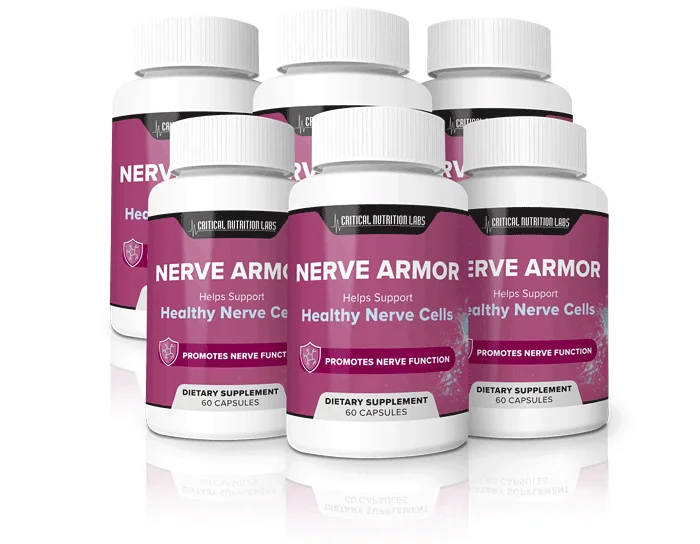
Nerve Armor is a capsule supplement for nerve pain, sold with a long-form sales page that frames the cause of nerve pain as overactive immune cells nicknamed 'termite cells' (a dramatized name for microglia) that damage the protective myelin sheath around nerves. A bottle holds 60 capsules; the labeled serving is 2 capsules once a day, though the page pushes buyers toward 2 servings (4 capsules) a day for 'the fastest results,' which halves how long a bottle lasts.
The formula centers on palmitoylethanolamide (PEA), an anti-inflammatory compound the page says is equivalent to what is found in raw egg yolks, alongside Corydalis, Gotu Kola, granular alpha lipoic acid (ALA) and benfotiamine, a more absorbable form of vitamin B1.
It is sold by Critical Nutrition Labs, part of Critical Bench, Inc., with a listed Clearwater, Florida address, the same company and personality (Chris Wilson) behind Neuro-Thrive and Neuro-Balance Therapy, also sold through ClickBank.
Format: Veggie capsule, 60 per bottle, 2 capsules per serving (1 to 2 servings a day). Sold by: Critical Nutrition Labs / Critical Bench, Inc. (sold through ClickBank).
What is on the Nerve Armor label?
Each row compares what the label or sales page states with what published research used. When an amount is missing, there is nothing to compare, and we say so.
All five ingredients carry a stated milligram amount on the product label, which is more transparent than a hidden proprietary blend, but three of the five (Corydalis, Gotu Kola and especially ALA and benfotiamine) are dosed well below the amounts used in the human or animal research the page cites to support them.
Do the Nerve Armor claims hold up?
"Scientists have discovered... a destructive cell... they call it a 'Termite Cell'" that eats through nerves
This is a dramatized nickname for microglia, real immune cells in the nervous system with a documented role in nerve inflammation. The 'termite' framing and 4-symptom 'warning sign' checklist are marketing devices layered on top of real but general neuroscience, not a diagnosis or finding specific to any individual reader.
"Concentrated PEA lowered overactive termite cells by 82%" and Gotu Kola caused a "460% reduction in termite cells"
These specific percentages come from lab or animal studies on immune cell activity, not human clinical trials measuring nerve pain relief in people taking Nerve Armor. They describe cell-level effects in a controlled setting, not a guaranteed outcome for a supplement user.
"We dosed each ingredient according to those [peer reviewed] studies"
This does not hold up for two of the five ingredients: the page's own cited alpha lipoic acid trial used 600 mg (Nerve Armor has 150 mg), and typical benfotiamine neuropathy trials use several times the 50 mg included here.
"You don't pay a single penny" if the product doesn't work, within 60 days
The seller's own Exchanges & Returns policy confirms a full refund of the purchase price within 60 days, but requires the customer to ship the product back to Ohio at their own expense, which is a cost the 'not a single penny' framing does not mention.
How much does Nerve Armor really cost?
| Option | Total | Per month | Shipping |
|---|---|---|---|
| 1 bottle | $59 | $59 | Plus $7.99 shipping and handling |
| 3 bottles | $147 | $49 | Free |
| 6 bottles | $234 | $39 | Free |
The sales page prices a 30-day, 1-bottle starter package at $59 plus $7.99 shipping, a 90-day, 3-bottle package at $49 a bottle ($147, free shipping) and a 180-day, 6-bottle package at $39 a bottle ($234, free shipping).
The ClickBank order form we opened for the single-bottle option (with a coupon variant applied) showed a $54.00 subtotal and a $61.99 total, consistent with a discounted bottle price plus the stated shipping fee, confirmed in USD.
The page repeatedly pushes buyers toward doubling the daily dose to 2 servings, which means a 1-bottle order actually lasts 15 days rather than 30 at that recommended intake, effectively doubling the real monthly cost for anyone who follows the 'best results' advice with a single bottle.
Shipping is an extra $7.99 on the single-bottle order and free on the 3 and 6 bottle bundles, per the pricing boxes on the sales page. A bottle holds 60 capsules (30 servings of 2 capsules); the page recommends doubling to 2 servings a day, which makes a single bottle last 15 days instead of 30.
Can you get a refund on Nerve Armor?
60-day window. The sales page says 'you don't pay a single penny' if unsatisfied within 60 days. The seller's own Exchanges & Returns policy is narrower: a full refund of the purchase price is available within 60 days, but the customer must ship the product back to the company's Ohio facility at their own expense.
Step by step: find the ClickBank receipt email, look up the order at clkbank.com and ask for a refund in writing. Our ClickBank refund guide covers returns, extra offers and auto-ship.
Which red flags did we find?
- Two doses fall well short of the studies citedAlpha lipoic acid (150 mg) is a quarter of the 600 mg dose in the page's own cited trial; benfotiamine (50 mg) is a fraction of typical neuropathy study doses.
- Dramatic percentages sourced from lab and animal studiesStatistics like an '82% reduction' or '460% reduction' in 'termite cells' come from cell-culture or animal research, not a trial of people taking this product.
- Fear-based framing of consequencesThe page links nerve pain to memory loss, heart problems, falls and assisted living to build urgency, beyond what the cited general sources establish for a nerve-support supplement.
- Refund is not truly cost-free"You don't pay a single penny" if unsatisfied is contradicted by the actual return policy, which makes the customer pay return shipping to get the refund.
- Manufactured urgency and stock scarcityThe page repeatedly warns the order may be 'given away' if you leave the page and that the product could be 'out of stock for months,' pressure tactics common across this seller's other pages.
Who should buy Nerve Armor, and who should skip it?
It may suit you if
- You want to see the exact ingredient amounts before buying, and PEA specifically at a dose used in real pain research.
- You are comfortable paying for return shipping yourself if you use the 60-day refund.
Skip it if
- You are looking for alpha lipoic acid or benfotiamine at the doses used in diabetic neuropathy trials; both are well under those amounts here.
- You want evidence drawn from human trials of the actual product rather than lab and animal statistics about individual ingredients.
- You are uncomfortable with fear-based marketing that links ordinary nerve pain symptoms to assisted living and heart problems.
How we assessed this
We did not buy or use Nerve Armor. This review audits the offer as it appeared on September 28, 2026. We read:
- The Nerve Armor sales page at nervearmor.org reached through our ClickBank link, including its embedded supplement facts label image
- The site's Contact & Shipping Policy page, including the Exchanges & Returns Policy section
- The ClickBank order form for the 1-bottle package (orders.clickbank.net), viewed with US billing settings
- The page's own reference list, including the 2021 alpha lipoic acid trial (Karalis et al., Cureus) and the benfotiamine cell-culture study it cites
- Published research on PEA, Corydalis, Gotu Kola, alpha lipoic acid and benfotiamine dosing for nerve-related conditions
Sources
- Karalis et al. 2021, effect of alpha-lipoic acid on diabetic peripheral neuropathy (Cureus, via PubMed)
- Bozic et al. 2015, benfotiamine upregulates antioxidative system in activated BV-2 microglia cells (PubMed)
- ClickBank customer support (orders and refunds)
Scores: evidence 3, price 5.5, refund 5.5, transparency 4. How we score.
Want a second opinion?
Worthorpass reviews the same offer from the checkout side: the real price on the order form, billing terms and delivery. Read the Worthorpass offer review of Nerve Armor and compare it with our dose and price audit above.
Nerve Armor FAQ
Is Nerve Armor legit?
It is sold by an identifiable company, Critical Nutrition Labs / Critical Bench, Inc., with a real address, and it discloses a full ingredient label. The concerns are two ingredients dosed well below the studies cited for them, dramatic 'termite cell' statistics drawn from lab and animal research, and a refund that requires the customer to pay return shipping despite the 'not a single penny' language on the sales page.
How much does Nerve Armor cost?
One bottle (a 30-day supply at the labeled serving) is $59 plus $7.99 shipping. A 3-bottle, 90-day supply is $147 with free shipping, and a 6-bottle, 180-day supply is $234 with free shipping, working out to $39 to $59 a month.
What are the side effects of Nerve Armor?
The page states the ingredients are generally safe and compatible with most medications, but recommends checking with a doctor before starting if you take prescription drugs. Because several doses are lower than the amounts used in published trials, effects (positive or negative) seen in those studies may not carry over directly to this formula.
How do I get a Nerve Armor refund?
According to the seller's own policy, you have 60 days from delivery to return the product, with the original packing slip, to their Ohio shipping facility at your own expense, for a full refund of the purchase price.
What is in Nerve Armor?
Each 2-capsule serving contains palmitoylethanolamide (450 mg), Corydalis rhizome powder (150 mg), Gotu Kola whole-herb powder (150 mg), granular alpha lipoic acid (150 mg) and benfotiamine (50 mg).