Is Cardio Shield worth it?
Worth a look (5.4/10). Cardio Shield combines several ingredients, hawthorn, hibiscus, olive leaf, green tea, garlic and nattokinase, that do have published research behind them for blood pressure or circulation, alongside a standard B-vitamin stack at clearly labeled amounts. The problem is that all six of those plant ingredients are folded into a single 570 mg "Proprietary Blend," so there is no way to know whether any one of them reaches the dose used in the studies the marketing story leans on. The 180-day refund window is unusually generous and a real strength, and the invented backstory about a mysterious ex-Big Pharma scientist should be read as marketing, not fact.
What we liked
- 180-day, no-questions-asked money-back guarantee, longer than the ClickBank standard 60 days
- B-vitamins are individually dosed and clearly labeled
- Several blend ingredients (hawthorn, hibiscus, olive leaf, garlic) do have real published blood pressure research
- Named distributor with a listed address, rather than a fully anonymous brand
- Free shipping on the 3- and 6-bottle bundles
What we didn't
- Six active plant ingredients share one undisclosed 570 mg blend
- Founder origin story is unverifiable and reads as fabricated marketing
- "Pennies per day" claim understates the real $1.30-$2 daily cost
- Inflated "retail price" anchors ($99-$594) cannot be verified
- $39-$59 a month for a formula whose key doses cannot be checked
What is Cardio Shield?
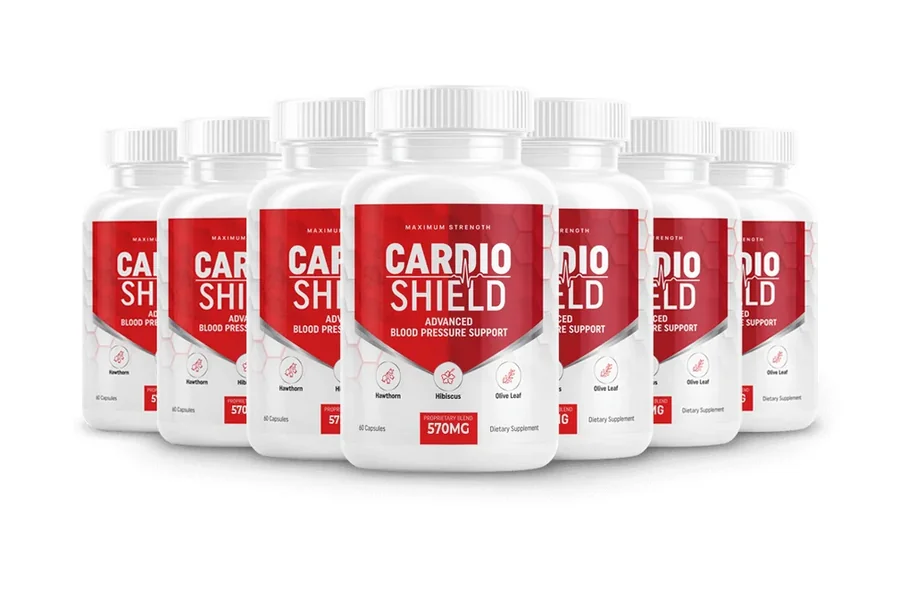
Cardio Shield is a capsule supplement sold as support for healthy blood pressure. The label lists a Maximum Strength formula of 60 capsules per bottle, a suggested use of two capsules daily, and pairs a set of clearly dosed B-vitamins (vitamin C, D3, K2, niacin, B6 and B12) with a 570 mg "Proprietary Blend" containing hawthorn leaf extract, olive leaf extract, nattokinase, green tea extract, garlic extract and hibiscus anthocyanins.
The sales page is built around a long personal narrative: a supplement-company employee named 'Jerry' has a near-fatal cardiac event, is given a secret list of ingredients by a mysterious scientist named 'Ryan' who works for a pharmaceutical company, and turns that list into Cardio Shield. This story cannot be verified and reads as a fictionalized sales device common to this style of advertorial, not a documented case history.
It is distributed by Apollo Research LTD, an address in London is given on the label, and it is sold through ClickBank, which appears as the retailer on the buyer's card statement and handles refunds.
Format: Capsule, 60 per bottle, 2 a day (30-day supply per bottle). Sold by: Apollo Research LTD (sold through ClickBank).
What is on the Cardio Shield label?
Each row compares what the label or sales page states with what published research used. When an amount is missing, there is nothing to compare, and we say so.
The B-vitamins are dosed individually and clearly on the label, which is a genuine positive. The six plant ingredients that carry the blood-pressure-support story, however, are combined into one 570 mg proprietary blend with no per-ingredient breakdown, which is the single biggest gap between this label and the studies its marketing invokes.
Do the Cardio Shield claims hold up?
A pharmaceutical-insider ('Ryan') gives the founder a secret list of blood-pressure-lowering nutrients
This narrative device cannot be verified and is a common storytelling format in ClickBank advertorials. The ingredients that follow (hawthorn, hibiscus, olive leaf, garlic, green tea, nattokinase) are not secret; they are widely available, commonly researched supplement ingredients, not a hidden discovery.
Hibiscus tea dropped systolic blood pressure by an average of 7.2 points in a study cited on the page
Hibiscus sabdariffa has real published trials showing modest systolic blood pressure reductions, generally in the mid-single digits over several weeks, roughly consistent with the figure cited. However, those trials used specific extract doses and preparations that cannot be confirmed against Cardio Shield's hidden blend amount.
Twin studies showed olive leaf extract lowered blood pressure by 11 points at the highest dose
Olive leaf extract has been studied for blood pressure with some positive results, but the specific dose that produced the largest effect in published research is unknown here, since the label does not state how much olive leaf extract this product actually contains within its 570 mg blend.
"The most Cardio Shield costs is just a few pennies per day"
At $39 to $59 per 30-day bottle, that works out to roughly $1.30 to $2 a day, not a few pennies. The claim understates the real cost of ongoing use.
How much does Cardio Shield really cost?
| Option | Total | Per month | Shipping |
|---|---|---|---|
| 1 bottle | $59 | $59 | $19.95 shipping and handling |
| 3 bottles | $147 | $49 | Free shipping |
| 6 bottles | $234 | $39 | Free shipping |
One bottle costs $59 plus $19.95 shipping and handling. Three bottles cost $147 ($49 a bottle) with free shipping, and six bottles cost $234 ($39 a bottle) with free shipping. Since one bottle is a 30-day supply, that works out to roughly $59, $49 or $39 a month depending on how much you buy up front.
The page anchors these prices against invented 'retail' prices of $99, $297 and $594, discounts that cannot be verified against any real sale history and should be treated as standard direct-response marketing rather than documented value.
There is no mention of an automatic subscription or recurring shipment in the text we could access; each bundle is presented as a one-time purchase.
The single-bottle order adds $19.95 shipping and handling. The 3-bottle and 6-bottle bundles ship free, according to the order boxes on the sales page.
Can you get a refund on Cardio Shield?
180-day window. The sales page states a full 180-day, 100% money-back guarantee, and says bottles can be returned opened or unopened, full or empty, for a full refund with no questions asked. The order is processed by ClickBank.
Step by step: find the ClickBank receipt email, look up the order at clkbank.com and ask for a refund in writing. Our ClickBank refund guide covers returns, extra offers and auto-ship.
Which red flags did we find?
- Six active ingredients hidden in one proprietary blendHawthorn, olive leaf, nattokinase, green tea, garlic and hibiscus share a single 570 mg total with no individual amounts, making it impossible to compare the label with the studies the sales page cites for each ingredient.
- Fictionalized origin storyThe founder narrative involving a near-fatal cardiac event and a secretive pharmaceutical scientist reads as a dramatized sales device rather than a documented history, and cannot be verified.
- Inflated anchor pricingThe page compares its bundles against invented "retail" prices as high as $594 for six bottles, a common scarcity tactic rather than a documented price history.
- "Pennies per day" understates the real costA 30-day bottle costs $39 to $59, which is $1.30 to nearly $2 a day, not pennies.
- "$140 billion cash cow" framingThe pitch positions the product as a threat to the pharmaceutical industry, a common rhetorical device in supplement marketing that is not evidence of effectiveness.
Who should buy Cardio Shield, and who should skip it?
It may suit you if
- You want to try a supplement with some individually studied plant ingredients for general cardiovascular support, understand the exact blend amounts are hidden, and plan to rely on the 180-day refund if it does not help.
- You already have your blood pressure monitored by a doctor and are looking for something to discuss adding alongside, not instead of, your current treatment.
Skip it if
- You take blood pressure medication or blood thinners. Nattokinase and garlic can both affect clotting and interact with blood pressure or anticoagulant drugs; the label itself tells you to consult a physician first.
- You want to verify the exact dose of hawthorn, hibiscus, olive leaf, garlic, green tea or nattokinase you're getting. A hidden 570 mg blend across six ingredients makes that impossible.
- You have diagnosed hypertension needing active management. This label explicitly warns it is not intended for people with cardiovascular disorders or hypotension without a doctor's input.
How we assessed this
We did not buy or use Cardio Shield. This review audits the offer as it appeared on September 28, 2026. We read:
- The Cardio Shield sales page (getcardioshield.com/cardio-shield) reached through our ClickBank link and its JS-tracker redirect
- The Supplement Facts label image published on the sales page, including the proprietary blend and B-vitamin amounts
- The three order bundles (1, 3 and 6 bottles) and their stated shipping terms
- The 180-Day Money Back Guarantee section
- PubMed search results confirming hawthorn extract and hibiscus sabdariffa are both genuinely studied for blood pressure
Sources
- PubMed search: hawthorn (Crataegus) extract and blood pressure/hypertension
- PubMed search: Hibiscus sabdariffa and blood pressure, randomized trials
- ClickBank customer support (orders and refunds)
Scores: evidence 4, price 5, refund 8.5, transparency 4. How we score.
Cardio Shield FAQ
Is Cardio Shield legit or a scam?
It is a real product sold through ClickBank with an unusually long 180-day refund, so it is not a scam that takes money for nothing. The main issue is transparency: its plant ingredients sit in an undisclosed 570 mg blend, and the founder story cannot be verified.
How much does Cardio Shield cost per month?
One bottle (a 30-day supply) is $59 plus $19.95 shipping. Buying three bottles brings it to $49 a bottle, and six bottles brings it to $39 a bottle, both with free shipping.
Can Cardio Shield replace blood pressure medication?
No. The label itself warns people with cardiovascular disorders or hypotension, or anyone on prescription medication, to consult a physician before use. It is not a substitute for medically prescribed treatment.
How do I get a Cardio Shield refund?
The sales page says to contact support for a full refund within 180 days of purchase, and that bottles can be returned opened or unopened. Your ClickBank receipt from clkbank.com is the fastest way to start that process.
What ingredients are in Cardio Shield?
Vitamin C, D3, K2, niacin, B6 and B12 at labeled amounts, plus a 570 mg proprietary blend of hawthorn leaf extract, olive leaf extract, nattokinase, green tea extract, garlic extract and hibiscus anthocyanins with no individual amounts given.