Is Joint Glide worth it?
Worth a look (5.8/10). Joint Glide stands out in this category because its label actually lists a milligram amount for every ingredient, something most ClickBank joint supplements hide behind a proprietary blend. Pine bark extract, devil's claw and white willow bark all have real published research behind them for joint pain and cartilage markers, and the doses generally sit in a reasonable range, though glucosamine (200 mg) and MSM (300 mg) fall well short of the 1,000 mg-plus amounts used in most clinical trials for those two ingredients. The sales narrative around a single 'rust enzyme' (MMP) and heavy metals as the hidden true cause of all joint pain simplifies a much more complicated picture and is not something we could verify as the dominant driver of joint pain in general. The 60-day, email-only refund is genuinely easy to use.
What we liked
- Every ingredient's amount is disclosed on the label, unusual for this product category
- Pine bark extract, devil's claw and white willow bark all have genuine published research for joint or pain-related outcomes
- 60-day money-back guarantee that only requires an email, even with an empty bottle
- Made in a US GMP-certified facility per the sales page, non-GMO and vegetarian capsules
- Free shipping on the 3- and 6-bottle packages
What we didn't
- Glucosamine and MSM doses are well below the amounts used in the clinical studies typically cited for them
- Devil's claw and white willow bark are not standardized to their active compounds, making their real strength hard to judge
- Sales narrative reduces joint pain to a single 'rust enzyme' cause and leans heavily on heavy-metal fear
- Listed 'regular prices' ($125 to $750) are not sold anywhere and appear to be inflated reference prices
- Copper dose is well above the standard daily value, a consideration for anyone taking other supplements with copper
What is Joint Glide?
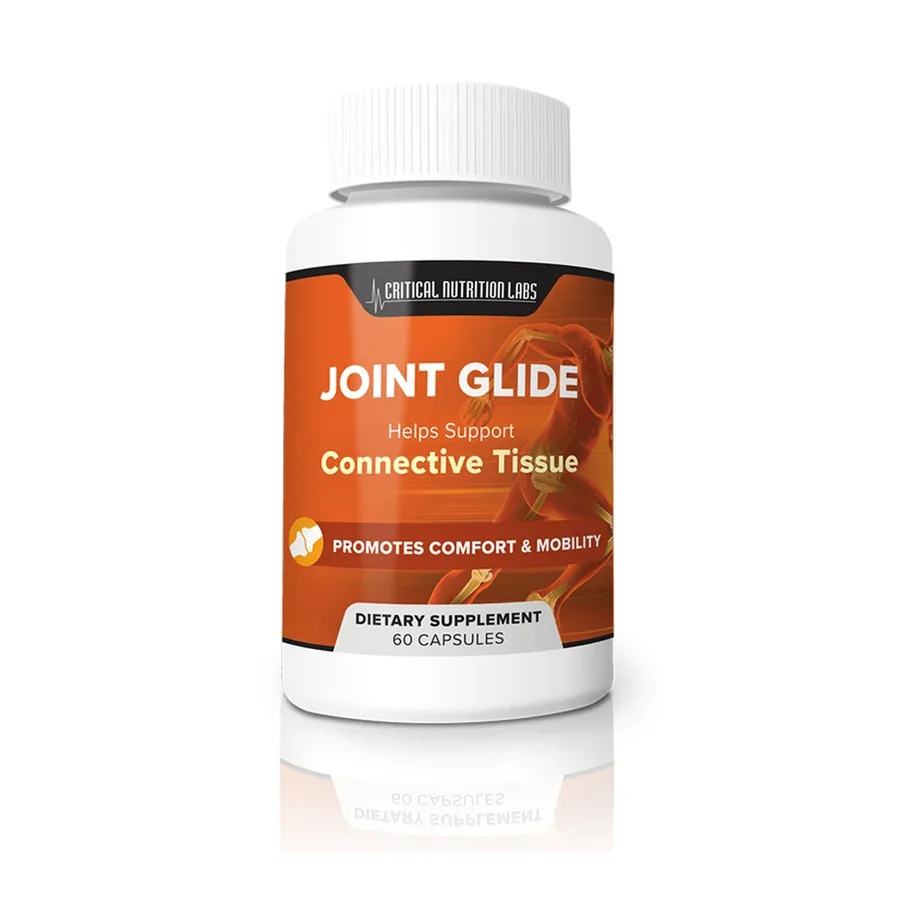
Joint Glide is a capsule from Critical Nutrition Labs sold as a joint-support formula that targets an enzyme called MMP (matrix metalloproteinase), branded on the sales page as a 'rust enzyme' said to be activated by toxic heavy metals stored in bone. The formula is credited to Chris Ohocinski, described as a state-licensed athletic trainer, and built around Pine Bark Extract (Pinus massoniana) plus nine other ingredients. A bottle holds 60 capsules taken two a day (30-day supply).
The label, which we found as a separate supplement-facts image rather than in the main sales text, lists actual amounts: Vitamin B6 0.5 mg, magnesium 100 mg, zinc 10 mg, copper 2 mg, organic devil's claw powder 500 mg, MSM 300 mg, glucosamine hydrochloride 200 mg, pine bark extract 150 mg (standardized to 95% proanthocyanidins), white willow bark extract 150 mg, and black pepper extract 10 mg (standardized to 95% piperine).
The sales page is a long story-driven presentation built around a fictionalized or anonymized client ('Sarah') and named testimonials, and frames the choice as either buying Joint Glide today or eventually needing surgery. It is sold through ClickBank, which appears on the buyer's card statement and processes payment and refunds.
Format: Capsule, 60 per bottle, 2 a day. Sold by: Critical Nutrition Labs (sold through ClickBank).
What is on the Joint Glide label?
Each row compares what the label or sales page states with what published research used. When an amount is missing, there is nothing to compare, and we say so.
Unlike most products in this category, Joint Glide's label gives a specific milligram amount for every ingredient rather than hiding them in a proprietary blend. Pine bark, zinc, copper, magnesium, B6 and piperine sit at reasonable amounts; glucosamine and MSM are well below typical clinical doses, and devil's claw and white willow bark lack the standardization data needed to compare them directly with the studies cited on the sales page.
Do the Joint Glide claims hold up?
Joint pain is primarily caused by a 'rust enzyme' (MMP) activated by toxic heavy metals stored in bone, not inflammation or wear and tear
Matrix metalloproteinases are real enzymes involved in cartilage breakdown, and some research links heavy metal exposure to joint tissue effects, but presenting this as the single true cause of joint pain, overriding wear and tear, injury, genetics and inflammation, oversimplifies a condition with many recognized causes.
"We dosed each ingredient according to those studies" (clinical-strength dosing)
This is true for several ingredients, such as pine bark extract and the mineral cofactors, but glucosamine (200 mg) and MSM (300 mg) fall well short of the doses used in the clinical trials typically cited for those two ingredients.
Devil's claw "reduced the rust enzyme by 25%" in a 609-person study, and pine bark extract "decreased the rust enzyme in humans by 50%"
Both devil's claw and pine bark extract do have published research on inflammatory and cartilage-related markers, which is more supporting evidence than many competing products cite. We could not confirm the exact percentage figures or that the study doses match what Joint Glide provides, since the devil's claw entry on this label is not standardized to a harpagoside percentage.
Turmeric and collagen supplements "speed up joint deterioration" because they concentrate heavy metals from contaminated soil and animals
There have been real, documented cases of lead-contaminated turmeric imported from some countries, which is a legitimate concern, but generalizing this to all turmeric and collagen products as actively harmful for joints goes beyond what the cited contamination reports show.
How much does Joint Glide really cost?
| Option | Total | Per month | Shipping |
|---|---|---|---|
| 1 bottle | $69 | $69 | $7.99 shipping fee |
| 3 bottles | $177 | $59 | Free shipping |
| 6 bottles | $294 | $49 | Free shipping |
A single bottle is $69 plus a $7.99 shipping fee (30-day supply). The 3-bottle 'Most Popular' package is $59 a bottle ($177 total, 90-day supply, free shipping), and the 6-bottle 'Best Value' package is $49 a bottle ($294 total, 180-day supply, free shipping).
At 2 capsules a day, the effective monthly cost ranges from about $49 (6-bottle deal) to roughly $77 (single bottle with shipping), placing it in the middle to upper-middle of the price range for joint supplements sold through ClickBank.
The single-bottle order adds a $7.99 shipping fee. The 3- and 6-bottle packages ship free. The page states orders typically arrive in 5 to 7 business days.
Can you get a refund on Joint Glide?
60-day window. The sales page offers a 60-day, 100% money-back guarantee that only requires emailing customer support, even if the bottle is empty. The order is processed by ClickBank, so a refund claim also goes through ClickBank support.
Step by step: find the ClickBank receipt email, look up the order at clkbank.com and ask for a refund in writing. Our ClickBank refund guide covers returns, extra offers and auto-ship.
Which red flags did we find?
- Single-cause 'rust enzyme' narrativeThe entire sales page attributes essentially all joint pain to one enzyme driven by heavy metals, a simplified story that leaves out other well-established causes of joint pain.
- Two key ingredients underdosed versus clinical studiesGlucosamine (200 mg) and MSM (300 mg) are far below the amounts used in the trials typically cited for these ingredients.
- Anchor pricing and urgencyThe page lists a 'regular price' of $125 to $750 that does not appear to be sold anywhere, alongside repeated countdown and stock-scarcity messaging.
- Case study and testimonials not independently verifiableThe 'Sarah' story and named customer quotes are presented as real outcomes but cannot be confirmed from outside the sales page.
Who should buy Joint Glide, and who should skip it?
It may suit you if
- You want a joint supplement where you can actually see the milligram amount of every ingredient rather than a hidden proprietary blend.
- You are comfortable with pine bark extract and devil's claw as the lead ingredients rather than a glucosamine-and-chondroitin-first formula.
Skip it if
- You are looking specifically for clinical-dose glucosamine or MSM; both fall well short of typical study amounts in this formula.
- You are put off by fear-based marketing built around a single 'true cause' of joint pain and heavy-metal alarm.
- You are already taking other supplements with copper or zinc, since this formula's copper amount is well above the standard daily value.
How we assessed this
We did not buy or use Joint Glide. This review audits the offer as it appeared on September 28, 2026. We read:
- The Joint Glide sales page (getjointglide.com) reached through our ClickBank link
- The separate supplement-facts label image on the same site, showing individual ingredient amounts
- The pricing tables, FAQ and guarantee terms on the sales page
- PubMed searches confirming published research exists on pine bark extract and on Harpagophytum procumbens (devil's claw) for joint and osteoarthritis-related outcomes
Sources
- Joint Glide sales page
- PubMed search: pine bark extract and osteoarthritis
- PubMed search: Harpagophytum procumbens (devil's claw) and osteoarthritis
- ClickBank customer support (orders and refunds)
Scores: evidence 4.5, price 5, refund 7.5, transparency 6. How we score.
Joint Glide FAQ
Is Joint Glide legit?
It is a real supplement with a labeled ingredient list, sold through ClickBank with an easy 60-day refund. Several ingredients (pine bark, devil's claw, white willow bark) have real research behind them, though the sales page's 'rust enzyme' framing oversimplifies the causes of joint pain, and two ingredients are dosed below typical study amounts.
How much does Joint Glide cost?
$69 plus shipping for one bottle, $177 for 3 bottles (free shipping), or $294 for 6 bottles (free shipping), based on the pricing on the sales page at the time we checked.
What are Joint Glide's ingredients?
Ten ingredients with disclosed amounts: pine bark extract 150 mg, devil's claw 500 mg, white willow bark 150 mg, MSM 300 mg, glucosamine HCl 200 mg, zinc 10 mg, copper 2 mg, magnesium 100 mg, vitamin B6 0.5 mg and black pepper extract 10 mg.
How do I get a Joint Glide refund?
The sales page states a 60-day money-back guarantee that only requires emailing customer support, even if the bottle is empty. Since ClickBank processes the order, you can also contact ClickBank support at clkbank.com with your order number.
Does Joint Glide have side effects?
The sales page states the ingredients are generally safe with most medications but advises anyone on prescription drugs to check with a doctor first. White willow bark contains salicin, related to aspirin, so people with an aspirin allergy or on blood thinners should be especially cautious and consult a physician.