
Is Nagano Tonic worth it?
Worth a look (5.3/10). Nagano Tonic is a powdered drink mix built around real, individually studied ingredients (green tea EGCG, ashwagandha, ginger, cinnamon, camu camu, Panax ginseng and more), and its reference list cites genuine published papers rather than made-up science, which is unusual for this category. The problem is that the supplement facts label buries every one of those ingredients inside four blends (a greens blend, an herbal blend, a digestive blend and a probiotic blend) with only a combined milligram total, so there is no way to check any single ingredient against the doses used in the studies it cites. We also found a leftover reference to a different ClickBank product, 'Red Boost,' inside this page's FAQ, a clear sign of copied, templated sales copy.
What we liked
- Ingredient list draws on real, individually published research rather than fabricated citations
- 180-day money-back guarantee, well above the standard 60-day ClickBank window
- Vitamin C and B12 are dosed individually rather than hidden in a blend
- Free US shipping on the largest (6-bottle) order
What we didn't
- Every herb, green and probiotic strain is buried inside combined blend totals with no per-ingredient amount
- Page contains leftover FAQ copy from a different ClickBank product ('Red Boost')
- No named parent company beyond the product's own brand name
- Probiotic content (2.5 billion CFU across 5 strains) is modest next to typically studied doses
- Shipping cost is unstated on the 1- and 3-bottle pricing tiers
What is Nagano Tonic?
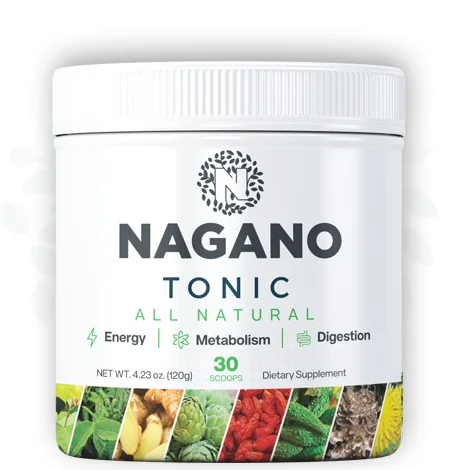
Nagano Tonic is a powdered supplement mixed into water or a beverage once a day. The sales page frames it as a metabolism-boosting 'Japanese elixir' aimed at fat loss, energy and anti-aging, built from ingredients including camu camu, green tea EGCG, mangosteen, Panax ginseng, bitter melon (Momordica charantia), ashwagandha, acerola, eleuthero root, alfalfa leaf, cinnamon cassia, ginger and inulin, plus a separate 'proprietary blend of 8 super antioxidants' (barley grass, spinach, blueberry, asparagus, cranberry, pomegranate, broccoli, spirulina).
The supplement facts label we retrieved from the sales page's own image folder confirms these ingredients are genuinely present, organized into four groups: a 'Super Food Greens and Antioxidant Blend' (2 g, 11 ingredients), a 'Nutrient Dense Natural Herbs and Extracts' blend (800 mg, 8 ingredients, including green tea extract standardized to 50% EGCG), a 'Digestive Complex' (406 mg, 4 ingredients) and a 'Probiotic Blend' (22.5 mg, 2.5 billion CFU across 5 named strains). Only vitamin C (75 mg) and vitamin B12 (25 mcg) are listed with individual amounts outside a blend.
The page ends with an unusually long reference list of real, checkable studies on ingredients like green tea EGCG, ginger, cinnamon, camu camu and ashwagandha. That list is more substantial than most ClickBank sales pages offer, but it cites research on these ingredients in isolation, generally at specific standalone doses, which cannot be compared with what a shared 800 mg herbal blend actually delivers of any one of them.
Format: Powder drink mix, 30 scoops per tub, 1 scoop a day mixed into water or a beverage. Sold by: Nagano Tonic (sold through ClickBank).
What is on the Nagano Tonic label?
Each row compares what the label or sales page states with what published research used. When an amount is missing, there is nothing to compare, and we say so.
The label names real, mostly well-researched ingredients, and vitamin C and B12 are dosed individually and reasonably. Everything else sits inside four combined blends with only a group total disclosed, so none of the herbal, greens, digestive or probiotic ingredients can be checked against the doses used in the studies the sales page itself cites.
Do the Nagano Tonic claims hold up?
Green tea EGCG has 'remarkable metabolism-boosting' properties
Real research supports green tea catechins/EGCG for modest metabolic effects at specific doses (commonly 300 mg+ EGCG/day in trials), but the label's 800 mg blend covers 8 ingredients together, so the actual EGCG delivered here cannot be confirmed.
Ashwagandha supports 'healthy stress-induced cravings and boosting metabolism'
A real trial (Choudhary et al., J Evid Based Complementary Altern Med, 2017, PMID 27055824) found ashwagandha root extract reduced stress-related outcomes in adults, but used a specific standalone dose, not a fraction of a shared blend.
'100% Satisfaction MONEY BACK GUARANTEE' for 180 days
Confirmed twice on the sales page and in the FAQ; a genuinely long refund window.
An FAQ answer titled 'Is Red Boost Safe?' appears on the Nagano Tonic page
Red Boost is a different ClickBank supplement. Its FAQ answer, left in place with the Nagano Tonic name absent, indicates this sales page reuses templated copy from another product's funnel.
How much does Nagano Tonic really cost?
| Option | Total | Per month | Shipping |
|---|---|---|---|
| 1 bottle | $79 | $79 | Shipping fee shown as '+Shipping' with no amount stated for this tier |
| 3 bottles | $177 | $59 | Shipping fee shown as '+Shipping' with no amount stated for this tier; includes 3 bonus guides |
| 6 bottles | $234 | $39 | Free US shipping; includes 3 bonus guides |
A single tub (a 30-day supply) costs $79 plus an unstated shipping charge. Three tubs cost $177 ($59/tub) and six tubs cost $234 ($39/tub) with free US shipping and 3 bonus guides included on both multi-bottle tiers.
At $39 to $79 a month depending on the tier, Nagano Tonic sits in the middle-to-upper range for ClickBank weight-management products. The page's own FAQ recommends the 3- or 6-month packages, since it claims the ingredients 'have their greatest effect after 90 days or more,' a common push toward the largest, most expensive order.
The 1- and 3-bottle tiers list an unspecified '+Shipping' charge on the pricing table; only the 6-bottle tier states free US shipping. Orders ship in 2-3 days and arrive in 5-7 days domestically or 10-12 days internationally, per the FAQ.
Can you get a refund on Nagano Tonic?
180-day window. The sales page states a '100% Satisfaction MONEY BACK GUARANTEE' for 180 days, well above the standard 60-day ClickBank window.
Step by step: find the ClickBank receipt email, look up the order at clkbank.com and ask for a refund in writing. Our ClickBank refund guide covers returns, extra offers and auto-ship.
Which red flags did we find?
- All active ingredients hidden inside proprietary blendsEvery herb, green and probiotic strain is listed only as part of a combined blend total (2 g, 800 mg, 406 mg or 22.5 mg), so none of them can be checked against the doses used in the page's own cited research.
- Leftover copy from a different product ('Red Boost')The FAQ includes an unedited question, 'Is Red Boost Safe?', referencing a different ClickBank supplement, an unmistakable sign of copy-pasted, templated sales pages.
- No named parent companyThe site's footer and legal pages identify only 'Nagano Tonic' with no distinct company name, officer or physical business address beyond the standard ClickBank retailer boilerplate.
- Probiotic count on the low side2.5 billion CFU spread across 5 strains is modest next to typical studied probiotic doses, and the label does not disclose how much of that total each individual strain contributes.
Who should buy Nagano Tonic, and who should skip it?
It may suit you if
- People who prefer a powdered morning drink over capsules and like the idea of a greens-and-herbs blend.
- Buyers comfortable with proprietary blends who mainly want a long refund window as their safety net.
- Those specifically interested in the studied ingredient list (EGCG, ashwagandha, ginger, cinnamon) even without being able to confirm the exact doses received.
Skip it if
- You want to verify specific ingredient doses against the clinical research; the blend format makes this impossible here.
- You are sensitive to stimulant-like ingredients or take medication that interacts with ginseng, ashwagandha or green tea extract, since exact amounts are not disclosed.
- A page reusing copy from another product's FAQ ('Red Boost') is a dealbreaker for your trust in the seller.
How we assessed this
We did not buy or use Nagano Tonic. This review audits the offer as it appeared on September 28, 2026. We read:
- The Nagano Tonic / Lean Body Tonic sales page (leanbodytonic.com) reached through our ClickBank hoplink
- The supplement facts label image hosted on the sales page's own image folder (supplement-fact-nw-2.png)
- The 1/3/6-bottle pricing table and FAQ section, including the leftover 'Red Boost' FAQ entry
- PubMed abstract confirming the cited ashwagandha stress/weight study (Choudhary et al. 2017, PMID 27055824)
Sources
- ClickBank customer support (orders and refunds)
- Choudhary et al. 2017, J Evid Based Complementary Altern Med: ashwagandha root extract and body weight management under chronic stress (PubMed)
Scores: evidence 4, price 5, refund 8.5, transparency 3.5. How we score.
Want a second opinion?
Worthorpass reviews the same offer from the checkout side: the real price on the order form, billing terms and delivery. Read the Worthorpass offer review of Nagano Lean Body Tonic and compare it with our dose and price audit above.
Nagano Tonic FAQ
Is Nagano Tonic legit?
It is a real powdered supplement with a disclosed supplement facts label and a working ClickBank checkout. Its reference list cites genuine published studies, but the page also contains leftover FAQ copy referencing a different product ('Red Boost'), which raises questions about how carefully the page was put together.
How much does Nagano Tonic cost?
One tub costs $79 plus shipping. Three tubs cost $177 ($59 each) and six tubs cost $234 ($39 each) with free US shipping, both multi-tub tiers including 3 bonus guides.
What are the ingredients in Nagano Tonic?
The label lists vitamin C and B12 individually, then groups everything else into four blends: a greens and antioxidant blend, an herbal and extract blend (including green tea EGCG, ashwagandha and Panax ginseng), a digestive complex, and a 5-strain probiotic blend. None of the blend ingredients have individually disclosed amounts.
How do I get a Nagano Tonic refund?
The sales page advertises a 180-day, 100% satisfaction money-back guarantee. Refunds for ClickBank purchases are requested through clkbank.com with the order number from your receipt email.
Does Nagano Tonic have side effects?
The label includes stimulant-adjacent ingredients like Panax ginseng and green tea extract plus ashwagandha, an adaptogen; amounts are not individually disclosed, so anyone on medication or sensitive to these ingredients should check with a doctor before use.