Is SonoVive worth it?
Worth a look (4.5/10). SonoVive is presented through a personal story from a man named Sam Olsen, with no credentials or photo to check, promising to "support the health of your hearing in a new and revolutionary way." The label we found on the site's own references page lists eight ingredients, and every one of them is dosed far below the amounts used in the research the brand's own reference list points to: 50 mg of ginkgo biloba against the 120 to 240 mg used in tinnitus trials, 10 mcg of huperzine-A against the hundreds of micrograms used in cognitive studies, and a phosphatidylserine ingredient diluted to 4 percent so the real active amount is a few milligrams, not the 125 mg printed on the label. It also includes St. John's Wort, an herb with no hearing-related research here at all but real interaction warnings for blood thinners, MAOIs and hormonal medication. At $49 to $69 a month, you are paying full supplement prices for trace amounts of researched ingredients.
What we liked
- 60-day money-back guarantee through ClickBank
- Free shipping within the US
- Full ingredient list and supplement facts panel are published, even if only on a secondary page
- Names a physical distribution address in Aurora, Colorado
What we didn't
- Every ingredient is dosed below the ranges used in its associated research
- Phosphatidylserine content is diluted to 4 percent, hiding the true active amount
- Includes St. John's Wort with real drug-interaction risk and no hearing-related rationale
- Formulator's identity and credentials cannot be verified
- "FDA approved facility" is inaccurate wording
- Cheaper pricing tiers only surface after you have already started checkout
What is SonoVive?
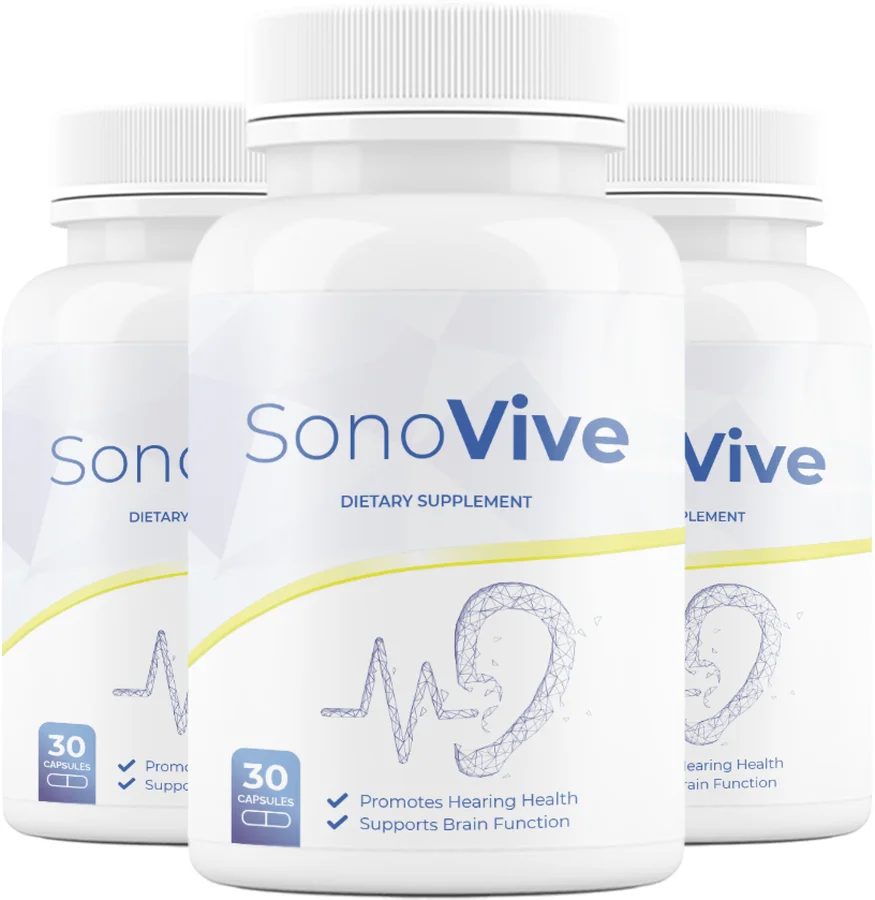
SonoVive is a capsule supplement sold as support for hearing health. The text sales page tells the story of "Sam Olsen," who describes himself as a retired medical chemist and says he combined plant extracts such as Ginkgo Biloba, St. John's Wort, Bacopa Monnieri, Vinpocetine and Huperzine-A into one formula after researching ways to support hearing. No last name is given for verification, no photo, and no credentials or license number appear anywhere on the page.
The sales page itself gives no ingredient amounts and no supplement facts panel; that information only appears on a separate references page, in an image of the physical product label. The label sets serving size at one capsule, with a suggested use of one to two capsules daily, while the sales copy markets a bottle of 30 capsules as a 30-day supply, which only holds if you take one capsule a day, the low end of the label's own suggested range.
It is sold through ClickBank, which appears on the card statement and handles the checkout and any refund request.
Format: Capsule supplement, 30 capsules per bottle, label says 1 to 2 a day. Sold by: SonoVive (sold through ClickBank).
What is on the SonoVive label?
Each row compares what the label or sales page states with what published research used. When an amount is missing, there is nothing to compare, and we say so.
Every one of SonoVive's eight ingredients is dosed at or below the low end of the research it is loosely associated with, and one of them (the phosphatidylserine complex) hides its true active content behind a percentage figure. The label itself is not shown on the main sales page; it only surfaces on a separate references page.
Do the SonoVive claims hold up?
"A formula that will support the health of your hearing in a new and revolutionary way"
No study on the SonoVive formula itself is cited anywhere on the site. The reference list links general articles and single-ingredient research, mostly at doses higher than what the label contains.
"Every bottle is made here, in the USA, in our FDA approved and GMP certified facility"
The FDA does not approve supplement manufacturing facilities; it registers them, and facilities are expected to follow good manufacturing practice. "FDA approved" overstates what that registration means.
Formulated by "Sam Olsen," a retired medical chemist
No last name, license, employer history or photo is given, so the credential cannot be verified.
"100% natural ingredients" with no dangerous stimulants or toxins
The label itself contradicts the "no cautions" impression: it carries a specific caution about St. John's Wort and bleeding risk, photosensitivity, and drug interactions with anticoagulants and MAO inhibitors.
How much does SonoVive really cost?
| Option | Total | Per month | Shipping |
|---|---|---|---|
| 1 bottle | $69 | $69 | Free in the US |
| 3 bottles | $177 | $59 | Free in the US |
| 6 bottles | $294 | $49 | Free in the US |
The sales page offers three bundles: 1 bottle for $69, 3 bottles for $177 ($59 a bottle) and 6 bottles for $294 ($49 a bottle). Since a bottle at the low end of the label's suggested use lasts 30 days, that works out to $69, $59 or $49 a month depending on how many bottles you buy up front.
The pricing data loaded by the page also contains post-purchase upsell and downsell tiers priced as low as $29 a bottle, which only appear after checkout rather than on the initial page. That means the sticker price on the first screen is not the lowest price the seller is willing to accept.
All bundles ship free within the US, and international shipping adds $15.95 regardless of bundle size.
Shipping is free in the United States (5 to 7 working days). Canada, the UK and Ireland, and Australia and New Zealand pay $15.95 with a 10 to 15 working day delivery, according to the site's shipping policy page.
Can you get a refund on SonoVive?
60-day window. The refund policy page promises a 60-day money-back guarantee from the delivery date. You email support, mention a refund in the subject line, and send back all the bottles (empty or not) to a physical address in Aurora, Colorado; return shipping is not covered. The purchase itself is processed by ClickBank.
Step by step: find the ClickBank receipt email, look up the order at clkbank.com and ask for a refund in writing. Our ClickBank refund guide covers returns, extra offers and auto-ship.
Which red flags did we find?
- Every dose sits below its own researchGinkgo, huperzine-A, vinpocetine, carnitine and bacopa are all listed at amounts below the ranges used in the studies loosely tied to them.
- Diluted phosphatidylserineThe 125 mg "4% complex" contains only about 5 mg of actual phosphatidylserine, far under typical study doses.
- Unverifiable creator story"Sam Olsen" has no surname, license or photo to check, despite being described as a medical chemist.
- "FDA approved facility" wordingThe FDA registers supplement facilities; it does not approve them.
- Irrelevant ingredient with real interaction riskSt. John's Wort has no cited hearing research here, but its own label caution lists interactions with blood thinners, MAO inhibitors and hormonal medication.
Who should buy SonoVive, and who should skip it?
It may suit you if
- You want to try a general wellness capsule, understand the doses are far below the research the brand cites, and plan to use the 60-day refund window if nothing changes.
- You are not taking blood thinners, MAO inhibitors or hormonal medication, since the St. John's Wort content carries interaction warnings for those groups.
Skip it if
- You take blood thinners, antidepressants, birth control, or have a bleeding disorder; the label's own caution flags all of these against St. John's Wort.
- You want doses that match published research. Several ingredients here are dosed at a fraction, sometimes a tiny fraction, of what studies actually tested.
- You have diagnosed hearing loss or tinnitus that needs medical evaluation. See an audiologist or doctor first.
How we assessed this
We did not buy or use SonoVive. This review audits the offer as it appeared on September 28, 2026. We read:
- The SonoVive text sales page (sonovive.com/text.php) reached through our ClickBank link
- The shipping policy and refund policy pages on sonovive.com
- The product label image on the site's references page, showing the full supplement facts panel
- The reference list linked from the site, including the Cochrane review of ginkgo biloba for tinnitus
- Published dosing ranges for huperzine-A, vinpocetine, phosphatidylserine and bacopa from clinical research
Sources
- Hilton MP et al. 2013, Ginkgo biloba for tinnitus (Cochrane Database of Systematic Reviews, PubMed)
- Jia JY et al. 2013, pharmacokinetics of a huperzine A analogue in healthy adults (PubMed)
- ClickBank customer support (orders and refunds)
Scores: evidence 2.5, price 5, refund 7, transparency 3.5. How we score.
SonoVive FAQ
Is SonoVive legit?
It is a real product sold through ClickBank with a 60-day refund, so it is not a scam in the sense of taking money for nothing. The concern is the formula: every ingredient is dosed well below the research the brand loosely cites, and the phosphatidylserine content is diluted to 4 percent.
How much does SonoVive cost per month?
At the label's minimum one-capsule-a-day use, one bottle lasts 30 days. It costs $69 a month bought singly, $59 a month in the 3-bottle bundle, or $49 a month in the 6-bottle bundle, with free US shipping.
Does SonoVive have side effects?
The product label itself warns that its St. John's Wort content can cause photosensitivity and interacts with blood thinners, MAO inhibitors and hormonal medication. Anyone on those medications, pregnant, nursing, or with a bleeding disorder should talk to a doctor first.
How do I get a SonoVive refund?
Email support within 60 days of delivery with "Refund Request" in the subject line, then mail back all the bottles, used or not, to the address on the refund policy page. Return shipping is not covered, and refunds are described as processed within 5 to 10 days after the return arrives.
What is in SonoVive?
The label lists St. John's Wort, L-Glutamine, a 4% phosphatidylserine complex, Bacopa Monnieri extract, Ginkgo Biloba, N-Acetyl L-Carnitine, Vinpocetine and Huperzine-A, all at amounts below the doses used in the studies loosely associated with them.