Is Vision 20 worth it?
Worth a look (5.8/10). Vision 20 is sold by Zenith Labs, a company with a real address and a named medical director, which is more transparency than most ClickBank supplements offer. But the sales page's story of '10 science-backed ingredients' (including beta-carotene, rose hips, vitamin A and taurine) does not match the supplement facts label we pulled from the product's own image library, which lists a different mix headed by zinc, bilberry, ginkgo biloba and maritime pine bark. The doses that are disclosed are mostly reasonable next to published eye-health research, but a marketing pitch built around ingredients the capsule does not contain is a real problem, not a technicality.
What we liked
- Named company with a real address (Zenith Labs, Aurora, CO) and a named medical director
- 180-day money-back guarantee, well above the standard 60-day window
- Actual label doses for lutein, zeaxanthin, bilberry and pine bark are within or close to published research ranges
- Full ingredient amounts disclosed on the label rather than hidden behind a proprietary blend
What we didn't
- Sales page markets 10 ingredients; 5 of them do not appear on the product's own supplement facts label
- Label includes 4 ingredients (copper, ginkgo, pine bark, astaxanthin) never mentioned in the marketing story
- Zinc dose (50 mg) exceeds the adult tolerable upper intake level
- Numbered citations [1]-[20] are not matched clearly to individual ingredient claims
- Ginkgo and pine bark extract can interact with blood-thinning medication, with no warning on the sales page
What is Vision 20?
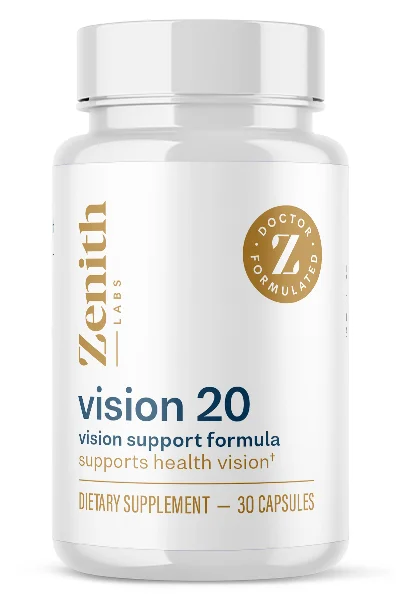
Vision 20 is a once-daily capsule sold by Zenith Labs, a supplement company that names a medical research director, Dr. Ryan Shelton, and lists a street address in Aurora, Colorado. The sales page frames the product around carotenoids, citing a large Harvard-affiliated observational study linking higher carotenoid intake to lower rates of age-related vision problems, then describes 10 ingredients it says were chosen to support near- and far-distance vision, low-light vision and age-related decline: lutein, zeaxanthin, zinc, beta-carotene, lycopene, rose hips, vitamin A retinyl palmitate, taurine, grape seed extract and bilberry extract.
We pulled the actual supplement facts label from the same product image library the sales page uses. It shows a materially different formula: zinc (as zinc citrate) 50 mg, copper (as copper citrate) 1 mg, bilberry fruit extract 160 mg, ginkgo biloba extract 160 mg, maritime pine bark extract (standardized to 95% proanthocyanidins) 150 mg, lutein 20 mg, lycopene 20 mg, astaxanthin powder 12 mg and zeaxanthin 4 mg. Five of the ten ingredients described in the sales copy, beta-carotene, rose hips, vitamin A retinyl palmitate, taurine and grape seed extract, are absent from the label entirely, while copper, ginkgo biloba, maritime pine bark and astaxanthin appear on the label but are never mentioned in the sales pitch.
The doses that are actually on the label are, for the most part, in line with published research on their own terms: the lutein and zeaxanthin amounts roughly double the AREDS2 trial doses (10 mg lutein, 2 mg zeaxanthin) in the same 5:1 ratio, and the bilberry and pine bark amounts sit within ranges used in published trials. The zinc dose of 50 mg, however, exceeds the US tolerable upper intake level of 40 mg per day for adults, though the label pairs it with a small copper dose, a standard way formulators offset zinc-related copper depletion.
Format: Capsule, 30 per bottle, 1 a day. Sold by: Zenith Labs (sold through ClickBank).
What is on the Vision 20 label?
Each row compares what the label or sales page states with what published research used. When an amount is missing, there is nothing to compare, and we say so.
Where the label discloses milligram amounts, most are within or close to ranges used in published eye-health research. The larger problem is that the label and the sales pitch describe two different formulas: beta-carotene, rose hips, vitamin A and taurine, all featured prominently in the marketing story, are not on the supplement facts panel at all.
Do the Vision 20 claims hold up?
"Vision 20 combines the top science-backed carotenoids with their absorption enhancer, Zinc"
Zinc is genuinely on the label at 50 mg, above the adult tolerable upper intake level of 40 mg/day, and lutein, lycopene and zeaxanthin are also present, so this specific pairing does exist in the actual product.
Beta-carotene 'protects your vision against overly-bright light' and 'slows the death of vision cells,' citing University of Colorado research
We could not verify this citation, and more importantly, beta-carotene does not appear anywhere on the product's own supplement facts label, so this ingredient story does not describe what is actually in the capsule.
Vitamin A Retinyl Palmitate and Taurine are two of the '10 ingredients' backed by 19 peer-reviewed studies
Neither ingredient appears on the label we pulled from the same product image library used by the sales page. The label lists ginkgo biloba, maritime pine bark and astaxanthin instead, none of which are described in the sales copy.
180-day, no-questions-asked money-back guarantee
Confirmed on the sales page's return policy section; this is a genuinely long window compared with the standard 60-day ClickBank guarantee.
How much does Vision 20 really cost?
| Option | Total | Per month | Shipping |
|---|---|---|---|
| 1 bottle | $59 | $59 | $9.95 domestic / $19.95 international |
| 3 bottles | $147 | $49 | $9.95 domestic / $19.95 international, plus 2 bonus guides |
| 6 bottles | $198 | $33 | Free, plus 2 bonus guides |
A single bottle (30 capsules, a 30-day supply) costs $59 plus $9.95 US shipping. Buying 3 bottles drops the price to $49 per bottle ($147 total) and 6 bottles to $33 per bottle ($198 total, free shipping), with two bonus guides included on the 3- and 6-bottle orders.
At $33 to $59 a month depending on the tier, Vision 20 sits in the middle of the pricing range for ClickBank eye-health supplements: not as cheap as a basic multivitamin, but not among the most expensive proprietary-blend formulas either.
The 1- and 3-bottle orders add $9.95 shipping in the US ($19.95 outside the US) on the order tiers shown on the sales page; the 6-bottle order ships free.
Can you get a refund on Vision 20?
180-day window. The sales page states a 180-day, no-questions-asked, money-back guarantee, well above the standard 60-day ClickBank window.
Step by step: find the ClickBank receipt email, look up the order at clkbank.com and ask for a refund in writing. Our ClickBank refund guide covers returns, extra offers and auto-ship.
Which red flags did we find?
- Sales copy and supplement label describe different formulasFive of the ten ingredients pitched on the sales page (beta-carotene, rose hips, vitamin A retinyl palmitate, taurine, grape seed extract) are not on the supplement facts label; the label instead lists copper, ginkgo biloba, maritime pine bark and astaxanthin, none of which the sales page mentions.
- Zinc dose above the adult upper intake levelAt 50 mg, the zinc dose exceeds the 40 mg/day tolerable upper intake level for adults; long-term intake above the UL can cause copper deficiency and other issues, though the label does include a small copper dose.
- No link to the 19 cited studies from individual ingredient claimsThe page numbers its claims [1] through [20] and lists reference URLs at the bottom, but does not connect specific numbered claims to specific studies in a way a reader can easily verify ingredient-by-ingredient.
- Testimonials without independent verificationCustomer quotes appear on the page through a third-party widget, with no way for us to confirm they reflect real, unpaid customers.
Who should buy Vision 20, and who should skip it?
It may suit you if
- Buyers who want a supplement from a company with a named, findable business address and medical director, rather than an anonymous storefront.
- People specifically interested in bilberry, pine bark and higher-dose lutein/zeaxanthin, since those are the ingredients genuinely on the label.
- Buyers who value a long refund window; 180 days is well above the ClickBank norm.
Skip it if
- You are buying specifically for beta-carotene, vitamin A, taurine or grape seed extract; none of those are on the actual supplement facts label.
- You are already near or over the recommended zinc intake from other supplements or your diet, since this product alone provides 50 mg.
- You take blood-thinning medication; ginkgo biloba and maritime pine bark extract are both on the label and can interact with anticoagulants.
How we assessed this
We did not buy or use Vision 20. This review audits the offer as it appeared on September 28, 2026. We read:
- The Vision 20 sales page (bestvisionsupport.com/cb) reached through our ClickBank hoplink
- The supplement facts label image hosted on the same product's cloud storage (label_vision20.jpg)
- The product bottle image and the 1/3/6-bottle pricing tiers shown on the sales page
- PubMed abstract for the AREDS2 trial (Chew et al., JAMA 2013, PMID 23644932) confirming the 10 mg lutein / 2 mg zeaxanthin doses used in that trial
- US National Academies tolerable upper intake level for zinc
Sources
- ClickBank customer support (orders and refunds)
- Chew et al. 2013, JAMA: AREDS2 randomized trial of lutein + zeaxanthin and omega-3s for AMD (PubMed)
Scores: evidence 3.5, price 6.5, refund 8.5, transparency 4.5. How we score.
Vision 20 FAQ
Is Vision 20 legit?
It is sold by Zenith Labs, a company with a named medical director and a real business address, which is more transparent than many ClickBank sellers. However, the sales page's ingredient story does not match the product's own supplement facts label, which is a real inconsistency.
How much does Vision 20 cost?
One bottle is $59 plus shipping. Buying 3 bottles brings it to $49 per bottle and 6 bottles to $33 per bottle, both with two bonus guides included.
What are the side effects of Vision 20?
The label's 50 mg zinc dose is above the adult tolerable upper intake level, and the label also contains ginkgo biloba and maritime pine bark extract, both of which can interact with blood-thinning medication. Check with a doctor if you take anticoagulants or other zinc supplements.
How do I get a Vision 20 refund?
The sales page advertises a 180-day, no-questions-asked money-back guarantee. Refunds for ClickBank purchases are requested through clkbank.com using the order number from your receipt email.
What ingredients are actually in Vision 20?
The supplement facts label lists zinc, copper, bilberry fruit extract, ginkgo biloba extract, maritime pine bark extract, lutein, lycopene, astaxanthin and zeaxanthin. This differs from the '10 ingredients' described on the sales page, which instead names beta-carotene, rose hips, vitamin A and taurine.